
Oil Shale and Natural Resources
Galoter Retorting Technology
We are proud to be pioneers in in unlocking and harnessing the immense potential of oil shale in Jordan
Galoter Retorting Technology
The Galoter process is oil shale retorting technology categorized as a solid heat carrier technology and uses a horizontal cylindrical rotating kiln-type retort. It is a process that has high thermal and technological efficiency, and high oil recovery ratio and its oil yield reaches reaching over 90%.
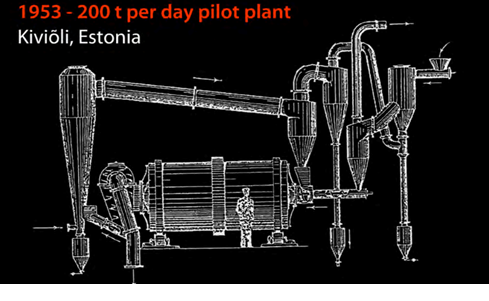
After thorough investigation, Galaxy Oil Shale has decided that the Galoter retorting technology is the most suitable and proven technology to be used in Jordan. The process was developed by the Krzhizhanovsky Power Energy Institute founded in 1930. Further development of the Galoter Process was carried out since 1953 with a series of successful oil shale retorting projects. Estonia had launched pilot units in 1953 and 1963. In 1980, the Narva started operating two Galoter-type units with a capacity of 3000 tons per day. More commercial units were installed in Estonia with different names such as Petroter, Solid Heat Carrie, Enefit.
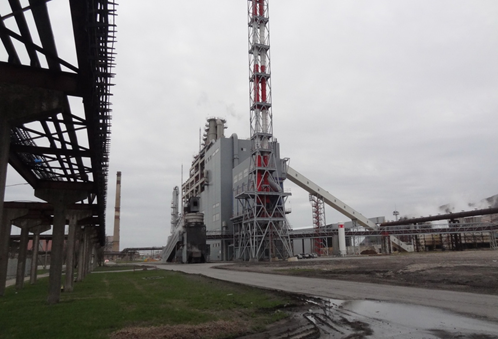
Galaxy Oil Shale
Our vision is to develop and operate Jordan’s oil shale resources with a focus on innovation, responsible environmental management, and achieving national economic benefit. To gradually transform Jordan from near-total dependence on imported energy sources to utilizing local oil shale energy resources, most importantly oil shale. At Galaxy Oil Shale, we are not just extracting natural resources, we are building a resilient energy future for Jordan and shaping tomorrow’s energy landscape.
Process
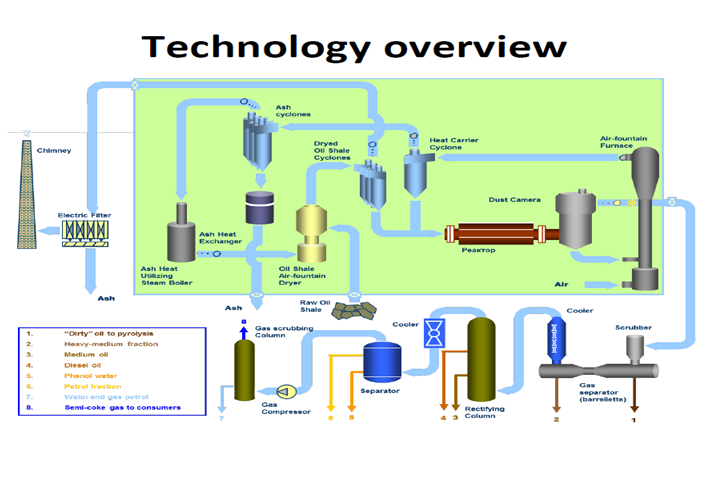
The oil shale is crushed into small particles and fed into drier by contact with hot ash. After drying the oil shale is then transported to a mixer chamber, where it mixed with hot ashes of 800 °C, produced by combustion of spent oil shale in a separate furnace. The mixture is then moved to a rotating kiln to start decomposition, known as pyrolysis, in oxygen deficit conditions and its temperature is kept at 520 °C. The produced oil vapors and gases are cleaned of solid particles by cyclones and moved to a condensation system where shale oil condenses. Spent shale (semi-coke) is transported then to the separate furnace for combustion to produce hot ash. A portion of the hot ash is recycled to the rotary kiln for pyrolysis.